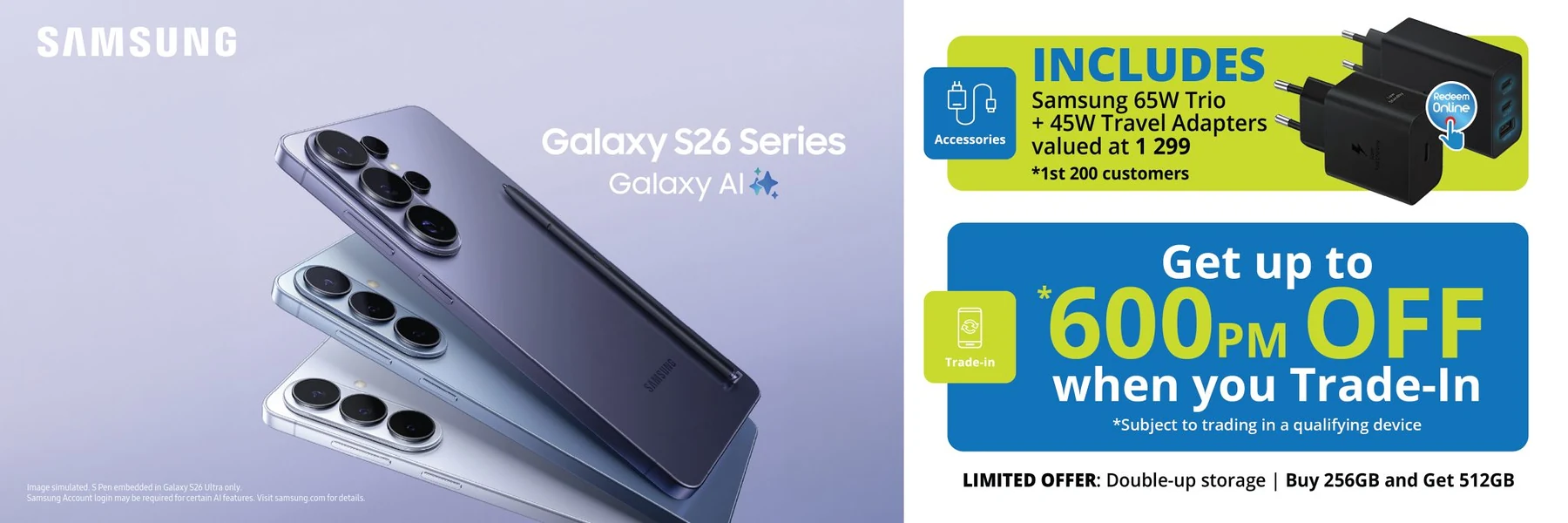
Samsung has played this one smart. The Galaxy S26 series does not scream reinvention, because it does not need to. Most people upgrading from a three-year-old phone do not care about a dramatic new silhouette as much as they care about a screen they can see in Joburg sun, a battery that survives a long day, and a phone that stops feeling clumsy when AI features are doing the work in the background.
That is the S26 pitch in South Africa: less theatre, more usefulness. The S26, S26+ and S26 Ultra lean into brighter displays, faster AI, tighter security, cleaner design and better battery efficiency, with the Ultra getting the sort of extras Samsung uses to tempt power users into paying more.
A cleaner body with less bulk
Samsung has trimmed the visual clutter. The rear camera area now sits in a translucent ambient island that flows into the frame instead of looking bolted on as a separate lump. It is a small design shift, but it makes the phones look less like spec sheets with screens attached.
The S26 Ultra is the most striking of the lot. At 7.9mm and 214g, Samsung is calling it the slimmest Ultra yet. All three phones use Armour Aluminium frames, even though earlier Ultra models used titanium. Samsung says aluminium gives a better balance, and that sounds like the kind of line that will matter once the phone is in a pocket all day, not on a launch slide.
The full range carries Corning Gorilla Glass and an IP68 rating, so the usual South African realities are covered too, from dusty commutes to the occasional splash, spill or beach day. Colour options are Cobalt Violet, Sky Blue, Black and White, which gives the range enough polish without drifting into boring flagship beige.
The screens are built for bad light and bright light
Samsung is pushing the display harder than the body. Every model gets a Dynamic LTPO AMOLED 2X panel with peak brightness set at 2600 nits. That matters in South Africa, where outdoor glare is not a corner case, it is the daily test.
The S26 uses a 6.3-inch FHD+ panel, the S26+ steps up to 6.9 inches at QHD+, and the S26 Ultra keeps the 6.9-inch QHD+ size with Samsung’s first Privacy Display. The trick is simple enough and useful enough. Sensitive content like notifications or PIN prompts can be hidden from side glances, which is exactly the kind of feature you appreciate on a packed Gautrain platform, in a taxi, or anywhere people are permanently reading over your shoulder.
Samsung also says mDNIe improves colour processing by four times, while ProScaler AI sharpens detail. Those are the kind of display claims that sound abstract until you scroll through photos, WhatsApp images and videos all day. Then they become either obvious or irrelevant very quickly.
The chip story splits the range
Samsung has split performance by model in a way that is easy to read. The S26 and S26+ use the Exynos 2600, a 2nm chip. Samsung claims it delivers 38% faster AI tasks, 23% better graphics and 7% faster processing.
The Ultra goes a different route with a customised Snapdragon 8 Elite Gen 5 on 3nm. Samsung says that chip brings a 39% NPU boost, 24% better GPU performance and 19% faster CPU speeds. On paper, the Ultra is the more aggressive machine. In practice, that should show up in heavier multitasking, more demanding photo edits and fewer slowdowns when AI features are working in the background.
All three phones get redesigned vapour chambers said to improve cooling by up to 29%. That matters more than the spec crowd likes to admit. A fast phone that throttles under pressure is just expensive disappointment.
The Ultra can be configured with up to 16GB of RAM, and the whole line runs Android 16 with One UI 8.5. Samsung is also promising seven years of updates, which is a real selling point if you keep a phone long enough to think beyond the next contract cycle.
The camera pitch is about editing as much as capture
Samsung is not just selling better cameras. It is selling a smarter photo workflow. The ProVisual Engine is meant to make images brighter and more intelligent, while the Ultra’s camera system does the heavy lifting.
The headline sensor is a 200MP wide camera at f/1.4, which Samsung says is 47% brighter. There is also a 50MP ultrawide lens at f/1.9, plus 3x and 5x optical zoom and 100x Space Zoom. The S26 and S26+ keep a 50MP triple-camera setup, while all models get AI-led improvements such as better skin tones and 8K recording.
For video, Nightography Video is meant to tame noise in low light, and Super Steady with Horizontal Lock is there for smoother handheld clips. That sounds aimed squarely at the real phone camera use case in South Africa, where people record family events, market scenes, travel clips and short social content more often than they shoot carefully framed stills.
The AI editing tools are the part most people will actually use. Photo Assist can respond to commands like adding a sunset, while Creative Studio turns sketches into stickers. Samsung says the system supports 41 languages, and Bixby can handle natural speech with regional English accents. That is the sort of detail that separates a global launch from something that has at least thought about local use.
Battery life is finally a proper argument
The battery specs are sensible rather than flashy. The S26 gets 4300mAh, the S26+ gets 4900mAh, and the Ultra reaches 5000mAh. Samsung claims up to 30 hours of video playback on the S26 and 31 hours on the S26+ and Ultra. It also says that is nine hours more than the S24 Ultra, thanks to better power management.
Charging speeds are stronger too. The Ultra can hit 75% in 30 minutes with 60W Super Fast Charging 3.0. The other models reach between 55% and 69% with wired charging rated from 25W to 45W. Qi2 wireless charging is supported, and reverse wireless sharing lets you top up earbuds or a watch from the phone itself.
Should S25 owners bother
Here is the blunt answer. If you already have an S25, the S26 series is a refinement, not a revolution. The display is brighter, the AI layer is sharper, the cameras are better in difficult light, and battery efficiency has improved. The biggest jump sits with the Ultra, especially if you care about the Privacy Display, the brighter main camera and the extra headroom from the Snapdragon chip.
If you are coming from an older phone, the case is much stronger. The S26 line looks like a more intelligent and better-balanced upgrade, the kind that will feel useful every day instead of impressive only when you are showing it off.
For South African buyers, that is the point. Samsung has not built a gadget for launch-day applause. It has built a phone family that tries to make the messy parts of mobile life, glare, battery anxiety, public privacy, quick edits, slower data, long days, feel a bit less annoying.